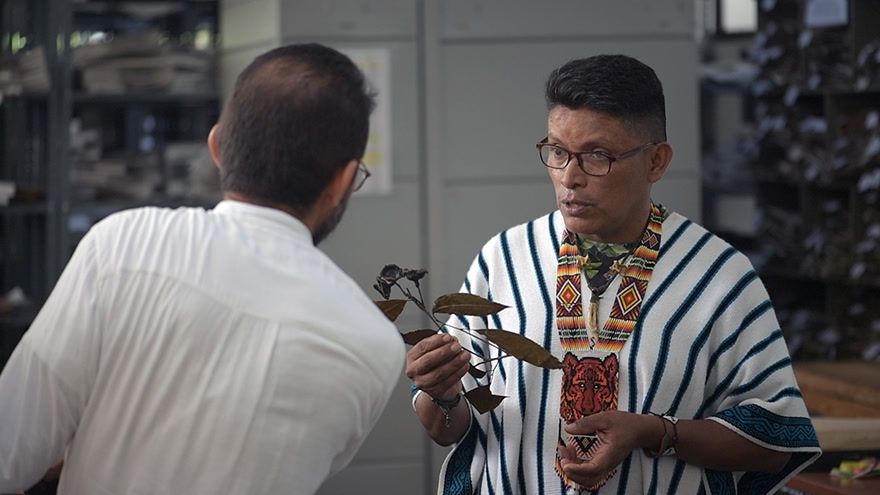
Beginning with the question: “How would scientific practice and the production of knowledge change if we assumed that plants are not mere specimens, but entities capable of knowing, acting, and constructing their own worlds?” Indexed Beings explores an alternative epistemology grounded in more-than-human intelligence. The work forms the second part of Knowles’s practice-based PhD trilogy and was created through collaboration with the Herbario Etnobotánico del Piedemonte in Mocoa, Putumayo, Colombia, together with the region’s Indigenous communities, including the Kamëntsá, Inga, Siona, and Cofán peoples.
The film begins with a reenactment of a dispute that took place inside the herbarium between a scientific researcher and a taita (traditional shaman). For the researcher, the herbarium functions as a scientific apparatus for safeguarding biodiversity. The taita, however, asserts that plants are not catalogued objects but autonomous beings. Through performance, filming, and dialogue, the work intertwines local plant life, Indigenous knowledge systems, and scientific taxonomies to illuminate the underlying question of who produces knowledge and how. Scenes oscillate between a taita touching the plants in an Indigenous laboratory and a researcher affixing labels to specimens—visually and symbolically destabilizing the status and authority of knowledge itself. The participatory structure of the work is equally significant: local residents, researchers, and the artist developed the script collectively through workshops, gradually reshaping the relationships between plants, humans, and machines. In this way, Indexed Beings functions as a device for rethinking plants not as experimental material or extractable resources, but as knowledge-bearing subjects. Through the work, Knowles questions human-centered epistemologies and seeks more diverse modes of knowing, being, and caring.