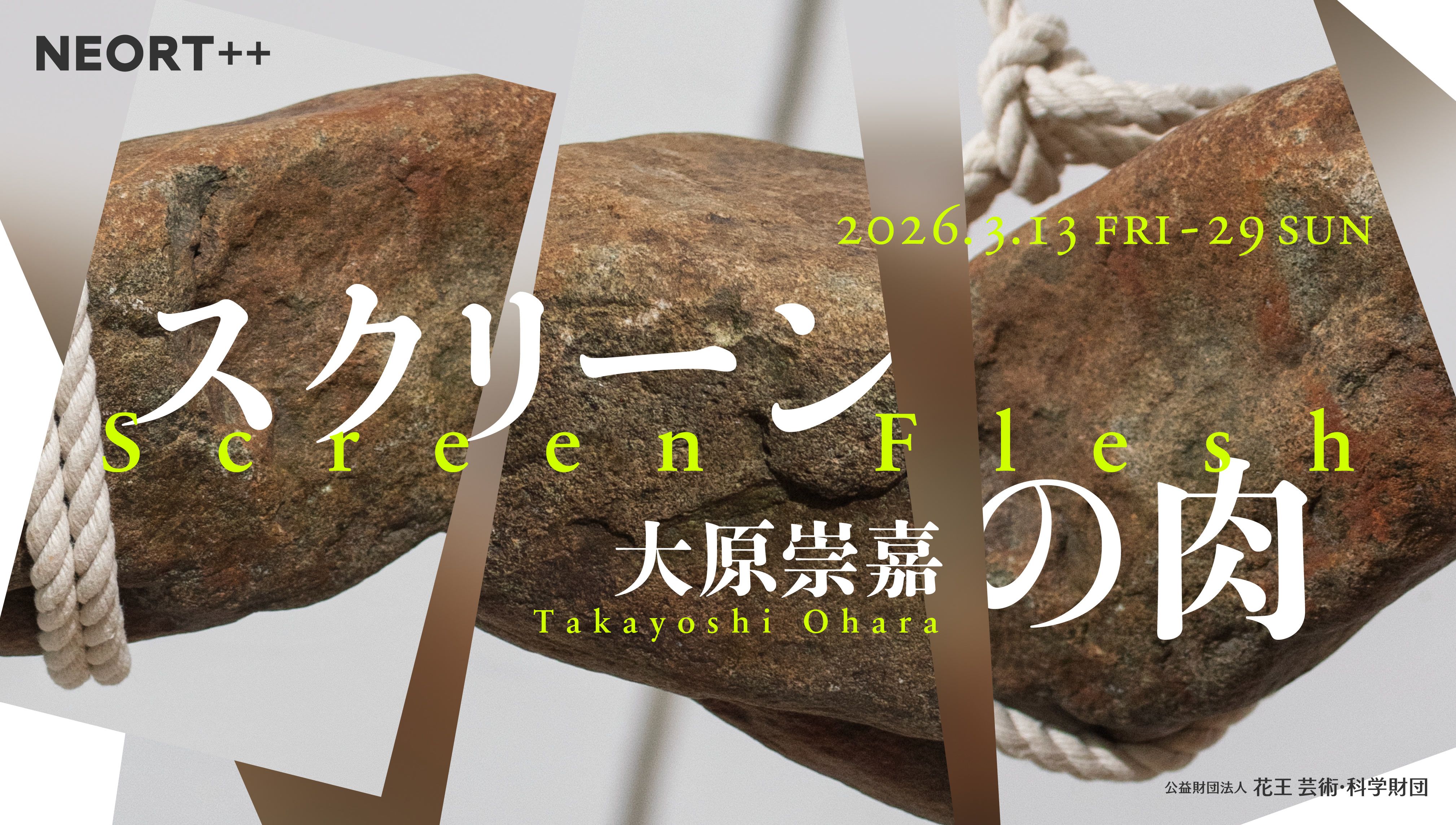
NEORT++ is pleased to announce the solo exhibition "Screen Flesh" by Takayoshi Ohara.
Statement
In recent years, video media has enhanced its transparency as a medium through improvements in resolution and frame rate. On the other hand, the widespread adoption of portable devices and the normalization of haptic interfaces have foregrounded the screen's surface, allowing video to be experienced as an interactive interface with the potential for touch.
These two trends are reminiscent of the modes of vision — "optical" (optisch) and "haptic" (haptisch) — distinguished by art historian Alois Riegl. While the former seeks to perceive objects at a distance within depth, the latter compresses distance and brings one closer to the surface. However, in today's media environment, these two modes do not switch exclusively; rather, perspectival depth and interfacial shallowness seem to be simultaneously emphasized and superimposed within the same experience.
Under these circumstances, video is transforming beyond the subject-object framework, becoming an event that encompasses the body's position and movement. Maurice Merleau-Ponty's phenomenology is insightful for considering this transformation. The body is not merely a device for receiving the world but a "lived body" (le corps propre) that generates meaning within relationships.
In this exhibition, the display itself is set in motion by motor control. Viewers engage with it by following it with their eyes, moving around it, and changing their distance and angle. In this space where depth and shallowness intersect, video emerges as a relationship arising between the body and space, gently unsettling the contours of perception.
Grant:The Kao Foundation for Arts and Sciences